
Why Kia engine reliability rankings matter in 2026

Kia engine reliability rankings measure how dependable specific Kia engines are over time, giving you a direct window into expected repair costs, maintenance demands, and long-term ownership satisfaction. These rankings are not just numbers on a chart. They reflect real-world failure rates, owner-reported problems, and engineering trade-offs that play out over hundreds of thousands of kilometres. In 2026, Kia scored 193 problems per 100 vehicles in the JD Power Vehicle Dependability Study, placing it near the top of mainstream brands. Understanding why Kia engine reliability rankings matter is the difference between a smart purchase and an expensive mistake.
Why Kia engine reliability rankings matter: how are they determined?
Reliability rankings for Kia engines come from two primary sources: JD Power surveys and Consumer Reports owner data. JD Power measures problems per 100 vehicles at two distinct points. The Initial Quality Study (IQS) captures issues within the first 90 days of ownership. The Vehicle Dependability Study (VDS) captures problems at the three-year mark. These are very different measurements, and confusing them leads buyers to wrong conclusions.
The distinction matters because Kia leads Hyundai long-term at three years with 193 PP100 versus Hyundai’s 198 PP100, yet Hyundai scores better at 90 days with 173 PP100 compared to Kia’s 181 PP100. A buyer who only checks early quality data would favour Hyundai, but a buyer planning to keep their vehicle for five or more years gets a different picture entirely.
Engine-specific factors that drive these scores include:
- Fuel delivery architecture: Multi-point injection (MPI) engines run cleaner and suffer fewer carbon build-up issues than direct injection (GDI) engines.
- Thermal management: Engines that maintain stable operating temperatures avoid the warping and seal failures that generate warranty claims.
- Software calibration: Precise software tuning acts as a protective layer, preventing over-fuelling, knock, and premature wear.
- Manufacturing tolerances: Tighter tolerances reduce vibration and uneven wear across the engine’s service life.
Pro Tip: When reading any Kia reliability review, check whether the score reflects the IQS or the VDS. A brand that scores poorly at 90 days but well at three years is often just dealing with software niggles, not fundamental mechanical failures.
What do Kia engine reliability rankings reveal about specific engine types?
The most important insight from Kia engine reliability data is that the brand’s reputation is not uniform. Specific engine architectures perform very differently, and buying based on the Kia badge alone ignores critical distinctions.
MPI engines like the Gamma 1.6 G4FC consistently achieve reliability scores around 82 out of 100, earning “Buy” ratings from independent reviewers. The Gamma 1.4 G4FA follows a similar pattern. These engines use port fuel injection, which keeps intake valves clean and reduces the carbon deposits that plague direct injection designs. They are straightforward to maintain and respond well to standard service intervals.
Pre-2019 GDI engines tell a different story. Many score below 68 out of 100 due to documented failures including rod-bearing wear and premature internal damage. The rod-bearing failures in older GDI engines are well-documented and linked to manufacturing tolerances that were tightened in later production runs. Buying a pre-2019 GDI-equipped Kia without checking the specific engine code and service history is a genuine financial risk.
| Engine type | Reliability score | Key concern |
|---|---|---|
| Gamma 1.6 MPI (G4FC) | ~82/100 | Minimal; strong long-term record |
| Gamma 1.4 MPI (G4FA) | ~80/100 | Low; suits city and light highway use |
| Pre-2019 GDI engines | Below 68/100 | Rod-bearing failures, carbon build-up |
| Lambda II V6 | Above average | Often underestimated; performs well |
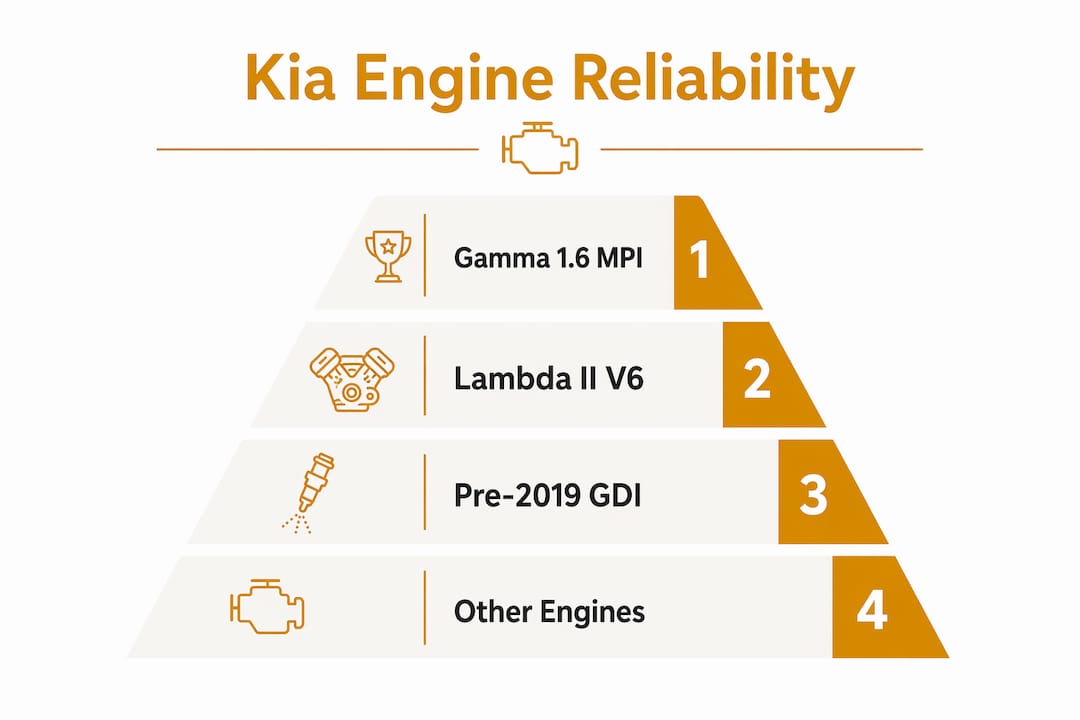
The Lambda II V6 deserves special mention. It carries a reputation for complexity, but the Lambda II V6 is more dependable than most buyers assume. Dismissing it based on outdated perceptions means overlooking a capable engine that suits larger Kia models well.
Pro Tip: Always cross-reference the engine code stamped on the block with the reliability data for that specific unit. The engine code tells you far more than the model year or trim level alone. You can find engine compatibility details using the Kia engine compatibility guide before committing to any purchase.
Why do Kia engine rankings matter financially and practically?
Reliability rankings translate directly into dollars. An engine that scores well on dependability studies costs less to own over five years because it generates fewer unplanned repair bills, holds its resale value better, and spends less time off the road.
Here is how the financial logic plays out for Kia owners:
-
Avoiding catastrophic repair costs. Thermal management and maintenance can prevent up to 90% of major engine failures. An engine ranked poorly signals that even diligent maintenance may not prevent expensive failures, because the underlying design or manufacturing is the root cause.
-
Recall completion rates affect real-world reliability. Kia’s recall completion rate between 2018 and 2022 averaged 51.9%, roughly 10 percentage points below the industry average. That gap means a significant portion of Kia vehicles on Australian roads may still carry unresolved safety or mechanical recalls. A VIN check before buying any used Kia is not optional. It is the single most practical step you can take.
-
Resale value protection. Vehicles with engines ranked highly for dependability retain value better at the three and five-year marks. Buyers in the used market pay attention to reliability data, and a Kia with a well-regarded engine code commands a stronger price.
-
Maintenance planning. Knowing your engine’s ranking tells you where to focus your service budget. A high-scoring MPI engine needs standard oil changes and timing belt replacements. A lower-scoring GDI engine may need additional carbon cleaning, oil consumption monitoring, and earlier inspection of internal components.
Reliability data is a financial planning tool, not just a purchasing guide. Owners who ignore it often discover the cost of that oversight at the worst possible time.
How do Kia rankings compare with Hyundai and Toyota?
Kia’s position in the reliability hierarchy has shifted considerably over the past decade. The brand moved from a budget option with mixed reviews to a mainstream contender that outperforms many established rivals on long-term dependability metrics.
The Kia and Hyundai comparison is the most instructive because the two brands share significant engineering. Despite that shared platform, Kia and Hyundai diverge in reliability trajectories, with Kia showing stronger long-term dependability past the three-year mark. This matters most for buyers of used vehicles, where the initial quality window has already passed.
Against Toyota, Kia still trails on the depth of its long-term track record. Toyota’s reliability data spans decades and covers millions of vehicles across diverse climates and use cases. Kia’s data set is younger and more concentrated in certain engine families. That does not make Kia unreliable. It means you need to be more specific when evaluating a Kia engine than when evaluating a Toyota Camry’s 2GR-FE.
Key considerations when using reliability rankings for buying decisions:
- Check the specific engine code, not just the model name. The Kia Sportage, for example, has been sold with MPI, GDI, and turbocharged variants across different years.
- Use the VDS score rather than the IQS score for vehicles more than 12 months old.
- Combine reliability rankings with a VIN-based recall check to identify any outstanding safety or mechanical issues.
- Review rebuilt car reliability data when considering older Kia models that may have had engine work completed.
The engine reliability comparison between Kia and its rivals is not a simple ranking. It is a matrix of engine types, model years, and ownership conditions. Buyers who treat it as a matrix make better decisions than those who rely on brand reputation alone.
Key takeaways
Kia engine reliability rankings give owners and buyers a precise, data-backed tool for predicting ownership costs and avoiding expensive failures across specific engine families.
| Point | Details |
|---|---|
| Rankings reflect engine-specific data | MPI engines score 80+ while pre-2019 GDI engines often fall below 68/100. |
| IQS vs VDS distinction matters | Kia scores better at three years than at 90 days, favouring long-term buyers. |
| Recall completion rates affect real reliability | Kia’s 51.9% recall completion rate means a VIN check is critical before any used purchase. |
| Thermal management prevents most failures | Up to 90% of major engine failures are preventable with correct maintenance habits. |
| Engine code beats brand reputation | Checking the specific engine code gives more accurate reliability data than the Kia badge alone. |
The detail most Kia buyers overlook entirely
I have seen buyers walk away from perfectly sound Kia vehicles because of a vague sense that “Kia engines have problems.” I have also seen buyers pay full price for pre-2019 GDI-equipped models without checking the engine code, then face rod-bearing repairs within 18 months. Both outcomes come from the same mistake: treating Kia as a single reliability story rather than a collection of distinct engine architectures.
The Lambda II V6 is a good example of how brand myths distort purchasing decisions. Most buyers hear “V6 Kia” and assume complexity equals unreliability. The data does not support that. The engine performs well across a range of applications, and owners who maintain it correctly report strong longevity. The problem is not the engine. The problem is the assumption.
What I find most useful is treating reliability rankings as a starting point, not a verdict. A score of 82 out of 100 on a Gamma 1.6 MPI tells you the base engineering is sound. It does not tell you whether the specific vehicle you are looking at has had its oil changed on schedule or its recall completed. That is where the VIN check and service history come in. Rankings predict population-level outcomes. Your job is to verify the individual vehicle.
For used Kia buyers specifically, the recall completion gap is the most underappreciated risk factor. A 51.9% completion rate means close to half of recalled Kia vehicles between 2018 and 2022 may not have had the fix applied. That is not a minor footnote. That is a structural risk that rankings alone will not reveal. Combine the data. Use all of it.
— Jason
Find the right Kia engine with Engine Zone
When your Kia engine rankings research points toward a replacement or upgrade, Engine Zone stocks a curated range of Kia engines tested and guaranteed for Australian conditions. Whether you are sourcing a reliable MPI unit to replace a worn GDI engine or looking for a certified Kia replacement engine that matches your model’s fitment requirements, Engine Zone provides transparent pricing, model fitment assistance, and fast delivery across Australia. The full Kia engine range covers the most common architectures, including Gamma MPI units that consistently top the reliability charts. If you are weighing up a new crate engine versus a used unit, the benefits of new crate engines guide walks you through the trade-offs clearly. Engine Zone’s team can also confirm compatibility before you buy.
FAQ
What does Kia’s 2026 VDS score actually mean?
Kia scored 193 problems per 100 vehicles in the 2026 JD Power Vehicle Dependability Study, placing it near the top of mainstream brands. A lower PP100 score indicates fewer reported problems and stronger long-term dependability.
Which Kia engines are the most reliable?
The Gamma 1.6 MPI (G4FC) and Gamma 1.4 MPI (G4FA) are the most consistently reliable Kia engines, scoring around 80–82 out of 100. Pre-2019 GDI engines score below 68 out of 100 and carry documented rod-bearing failure risks.
How does Kia reliability compare with Hyundai?
Kia outperforms Hyundai on long-term dependability at the three-year mark with 193 PP100 versus Hyundai’s 198 PP100, though Hyundai leads on initial quality at 90 days with 173 PP100 versus Kia’s 181 PP100.
Why should I check recall status on a used Kia?
Kia’s recall completion rate averaged 51.9% between 2018 and 2022, well below the industry average. That means a significant number of recalled Kia vehicles may still carry unresolved mechanical or safety issues that reliability rankings alone will not flag.
Does engine type matter more than the Kia model year?
Yes. The fuel delivery architecture (MPI versus GDI) and the specific engine code are stronger predictors of reliability than the model year alone. A 2018 Kia with a Gamma MPI engine will typically outperform a 2018 model fitted with a GDI unit of the same displacement.