
Engine fitment guarantee explained for car owners

An engine fitment guarantee is a formal commitment from a supplier that a replacement engine will physically and electronically fit your specific vehicle as described, with a remedy provided if it does not. This guarantee covers mounting points, ECU compatibility, transmission bellhousing patterns, and emissions compliance. For Hyundai and Kia owners, mechanics, and fleet operators across Australia, understanding fitment assurance is the difference between a clean engine swap and an expensive rework. This article breaks down exactly what the guarantee covers, how to verify compatibility before purchase, and why professional installation is part of the equation.
What is an engine fitment guarantee and what does it cover?
An engine fitment guarantee is the supplier’s assurance that the engine you purchase will fit and function in your nominated vehicle. The industry term you will see alongside this is engine compatibility guarantee, and both refer to the same commitment: the engine matches your car’s physical and electronic specifications, or the supplier makes it right.
Fitment guarantees differ per supplier but generally cover return shipping and a full refund or exchange if the engine does not fit as specified. That protection matters because an incompatible engine can sit in a workshop for days before the mismatch becomes obvious.
What a fitment guarantee typically covers:
- Mounting points and engine bay dimensions. The engine block must align with your vehicle’s subframe and mounting brackets without modification.
- ECU and immobiliser compatibility. Engine compatibility requires matching exact engine codes, electronics systems, and transmission compatibility. A mismatched ECU means the car will not start, or will run in a degraded limp mode.
- Transmission bellhousing pattern. The engine’s output flange must mate with your existing gearbox. A mismatch here is not a minor adjustment.
- Emissions compliance. The replacement engine must meet the legal emissions standards applicable to your vehicle’s registration year and state.
- Wiring harness integration. Connector positions and pin configurations must match your vehicle’s existing loom.
What a fitment guarantee does not typically cover includes damage caused by incorrect installation, modifications made after delivery, or wear items like seals and gaskets consumed during fitting.
Pro Tip: Always request the supplier’s fitment guarantee in writing before purchase. A verbal assurance is worth nothing if the engine arrives and the bellhousing pattern is wrong.
How to verify engine fitment before you buy
Verification is the step most buyers skip, and it is the step that makes or breaks a fitment guarantee. Confirming compatibility before purchase protects both the guarantee and your time.
- Match the engine code exactly. Your vehicle’s engine code is stamped on the block and listed in the compliance plate or owner’s manual. Cross-reference this code with the supplier’s listing. Do not assume that the same make and model across different production years shares an identical engine code.
- Check chassis and subframe specifications. Engine bay dimensions can vary between body styles of the same model. A Hyundai i30 sedan and hatchback from the same generation may share an engine code but differ in subframe geometry.
- Confirm transmission type and bellhousing pattern. Mismatched bellhousing patterns require extensive modifications that void most fitment guarantees. Confirm whether your vehicle runs a manual or automatic, and verify the pattern matches the replacement unit.
- Review ECU and immobiliser requirements. Some engine variants require a donor ECU and matching key transponder. Know this before the engine arrives on your workshop floor.
- Use specialist databases and dealership documentation. Engine Zone’s fitment verification guide outlines the specific checks required for Hyundai and Kia platforms. Dealership parts departments can also confirm compatibility using VIN-based lookups.
- Consult a qualified mechanic before purchase. A 30-minute consultation with someone who has swapped the same engine before saves hours of diagnostic work after the fact.
The risk of assuming “same make and model” guarantees a fit is real. Hyundai’s Theta II engine, for example, was used across multiple platforms with different ECU calibrations and mounting configurations depending on the production run.
Pro Tip: Take a photo of your existing engine’s compliance tag and send it to the supplier before ordering. Reputable suppliers will cross-check it against their stock before confirming the sale.
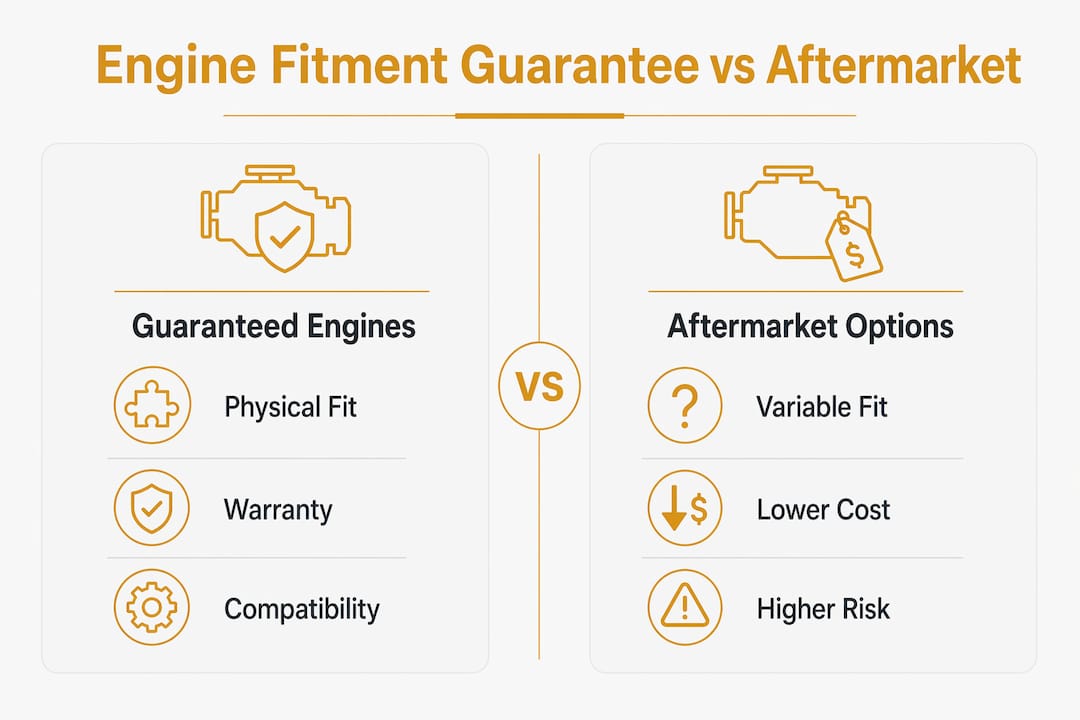
Guaranteed fitment engines vs non-guaranteed or aftermarket options
The choice between a guaranteed fitment engine and a non-guaranteed or generic aftermarket unit is a cost and risk calculation. The upfront price difference is real. The downstream cost difference is larger.
| Feature | Guaranteed Fitment Engine | Non-Guaranteed or Aftermarket Engine |
|---|---|---|
| Physical fit assurance | Confirmed against vehicle specs | Buyer assumes compatibility risk |
| ECU and electronics match | Verified by supplier | Often unverified |
| Warranty coverage | Clearly documented parts warranty | Limited or absent |
| Return or exchange policy | Covered if misfit occurs | Typically not available |
| Installation confidence | High | Variable |
| Long-term cost risk | Lower | Higher due to rework potential |
OEM components are manufactured to exact factory specifications with backing warranties, and guaranteed fitment engines follow the same principle. The supplier has already done the compatibility work, so you are not paying a mechanic to discover a mismatch on the hoist.
Non-guaranteed engines carry several common pitfalls:
- Fit mismatches discovered only after the old engine is removed
- Electrical problems from incompatible ECU or wiring configurations
- Emissions non-compliance that affects registration or roadworthy certification
- No recourse if the engine fails to start or perform as expected
Remanufactured engines with strong warranties offer coverage often comparable to new engines, providing genuine peace of mind. This makes a remanufactured unit with a fitment guarantee a credible alternative to a brand-new crate engine for budget-conscious buyers. The key is that the guarantee must be explicit, documented, and backed by a return policy.
For Hyundai and Kia owners, the right replacement engine is one where the supplier has already matched the engine code, ECU type, and mounting configuration to your specific variant. That pre-verification is the core value of fitment assurance.
Why professional installation makes the fitment guarantee work
A fitment guarantee covers the engine as supplied. It does not cover what happens if the installation goes wrong. Modern engines integrate with vehicle electronics and legal standards, requiring expert fitting services to realise the full benefit of the guarantee.
Modern engine swaps are rarely plug-and-play. The complexity includes:
- ECU programming and immobiliser syncing. Many modern Hyundai and Kia engines require the ECU to be paired to the vehicle’s body control module. This is not a task for a general-purpose scan tool.
- Emissions testing post-installation. Some states require a post-swap inspection before the vehicle can be registered or returned to service.
- Wiring harness adaptation. Even when the engine code matches, connector positions can differ between production batches, requiring loom adaptation.
- Diagnostic verification. A post-installation road test and scan for fault codes confirms the engine is operating within specification.
Comprehensive engine supply and fitting packages offer better reliability and warranty coverage than sourcing parts and labour separately. The single-point accountability model means one party is responsible for diagnostics, installation, testing, and the warranty. If something goes wrong, there is no dispute between the parts supplier and the workshop.
Accredited workshops with modern diagnostic equipment reduce installation issues and warranty claims significantly. When you choose a workshop, ask specifically whether they have experience with your engine platform and whether they carry the diagnostic software for your vehicle brand.
A DIY installation on a modern engine is a high-risk approach. The mechanical work may be sound, but without the correct scan tool and software access, ECU pairing and immobiliser syncing are effectively impossible on most post-2015 Hyundai and Kia platforms. An unpaired ECU means the car will not start, and the fitment guarantee will not cover a self-inflicted programming failure.
Key takeaways
An engine fitment guarantee is only as strong as the verification process behind it and the professional installation that follows.
| Point | Details |
|---|---|
| Fitment guarantee definition | A supplier’s commitment that the engine will physically and electronically match your vehicle as specified. |
| Core coverage areas | Mounting points, ECU compatibility, bellhousing pattern, emissions compliance, and wiring harness fit. |
| Verification is non-negotiable | Match exact engine codes, chassis specs, and transmission type before purchase to keep the guarantee valid. |
| Guaranteed vs non-guaranteed | Guaranteed fitment engines carry lower long-term cost risk due to documented compatibility and return policies. |
| Professional installation matters | Expert fitting with accredited workshops protects the guarantee and handles ECU pairing and emissions compliance. |
The part of engine fitment guarantees nobody talks about
I have watched experienced mechanics spend two full days diagnosing a no-start condition on a freshly installed engine, only to find the ECU was from a slightly different production variant. The engine code matched. The mounting points matched. The bellhousing was perfect. But the immobiliser calibration was off by one software revision, and the car refused to run. The supplier’s fitment guarantee covered a return, but the labour was already spent.
That experience changed how I think about fitment assurance. The guarantee is not just a returns policy. It is a signal about how seriously the supplier has done their homework before listing the engine. A supplier who offers a documented fitment guarantee has, by definition, mapped the engine to specific vehicle applications. That mapping work is what you are actually paying for.
The other thing I have noticed is that buyers often treat the guarantee as a safety net rather than a starting point. The right approach is to use the guarantee as confirmation that the supplier has verified compatibility, then add your own verification on top. Check the engine replacement process yourself, confirm the engine code with your mechanic, and only then place the order. Two layers of verification beat one every time.
For Hyundai and Kia platforms specifically, the production variation between model years is significant enough that a guarantee without specific variant confirmation is not worth much. Always ask the supplier to confirm compatibility against your VIN, not just your make and model.
— Jason
Find guaranteed fitment engines at engine zone
Engine Zone stocks new crate engines and tested replacement units for Hyundai and Kia vehicles across Australia, with fitment guarantees backed by documented compatibility checks and fast delivery. Every listing includes model fitment details so you know exactly what you are buying before checkout.
If you are weighing up your options, the benefits of new crate engines guide covers warranty terms, fitment assurance, and why a new unit often saves more in labour than the price difference suggests. For those comparing options, the crate engine vs rebuilt engine breakdown helps you choose the right path for your build and budget. Engine Zone also offers up to 25% off selected engines with free shipping across Australia.
FAQ
What is an engine fitment guarantee?
An engine fitment guarantee is a supplier’s commitment that a replacement engine will physically and electronically fit your specified vehicle. If the engine does not fit as described, the supplier provides a return, exchange, or refund.
What does an engine fitment guarantee cover?
It covers mounting point alignment, ECU and immobiliser compatibility, transmission bellhousing pattern, wiring harness fit, and emissions compliance. It does not typically cover damage from incorrect installation or post-delivery modifications.
Does a fitment guarantee cover installation costs if the engine does not fit?
Most fitment guarantees cover return shipping and a replacement or refund for the engine itself. Labour costs already incurred are generally not covered, which is why verifying compatibility before purchase is critical.
How do i confirm an engine will fit before buying?
Match the exact engine code from your compliance plate or owner’s manual against the supplier’s listing, confirm the transmission bellhousing pattern, and verify ECU compatibility. Using a VIN-based lookup through a dealership or specialist supplier adds a further layer of confirmation.
Is professional installation required to keep the fitment guarantee valid?
Most suppliers require installation by a qualified mechanic to maintain warranty and guarantee coverage. Modern engine swaps involve ECU programming and emissions compliance that cannot be completed without professional diagnostic equipment.