
Crate engine vs rebuilt engine: which is right for you?

A crate engine is a fully assembled, brand-new unit offering predictable performance and factory-style quality control, whereas a rebuilt engine is a disassembled and restored original engine with quality that varies significantly depending on the shop and parts used. For vehicle owners weighing up a crate engine vs rebuilt engine decision, the right choice comes down to five factors: cost, reliability, turnaround time, warranty strength, and how you use your vehicle. Both options have genuine merit, but they suit very different situations. Understanding the differences between crate and rebuilt engines before you commit will save you money, frustration, and unexpected downtime.
What are the key differences between crate and rebuilt engines?
A crate engine is typically a fully assembled, brand-new unit with dyno testing and a factory-style warranty often around 24 months or 50,000 miles. That means every unit leaves the factory with documented performance data, consistent tolerances, and no reliance on a single technician’s skill level. The predictability alone is a major advantage over the alternative.
A rebuilt engine starts life as your original block. A machine shop disassembles it, replaces worn components, and reassembles it to a serviceable condition. The critical word here is “serviceable.” Rebuild quality varies widely; a reputable machine shop with documented procedures can produce a near-new engine, while a low-quality rebuild can leave you worse off than before. The difference between those two outcomes often comes down to whether the shop performed the full suite of machining steps.

It is worth distinguishing rebuilt engines from remanufactured engines, since the terms are often confused. Remanufactured engines are restored to defined standards with stronger quality control, while rebuilt engines depend heavily on individual shop practices. A remanufactured unit sits closer to a crate engine in terms of consistency. A standard rebuild sits at the other end of the spectrum.
Pro Tip: When evaluating a rebuild quote, ask the shop specifically whether they bore and hone the cylinders, line-hone the mains, deck the block, and resurface the heads. A shop that cannot answer those questions confidently is one to avoid.
Quality control and standardisation
Crate engines from OEM suppliers or trusted builders like GM Performance Parts or Ford Racing go through controlled assembly processes with defined tolerances. Every unit is the same. Rebuilt engines, by contrast, are only as good as the machinist who built them. High-quality rebuilds require boring, honing, line-honing mains, decking the block, and head resurfacing. Skip any of those steps and you are installing a compromised engine regardless of how low the price looks.
Turnaround time
Engine rebuilds often take around 4 months, while crate engines can arrive within about 4 days. Machine shop scheduling, parts sourcing, and detailed machining all extend rebuild timeframes. For anyone who depends on their vehicle daily, that gap is not a minor inconvenience. It is a genuine cost.
How do the costs compare?
Cost is where most people start the crate engine vs rebuilt engine conversation, and the numbers are more nuanced than a simple sticker price comparison.
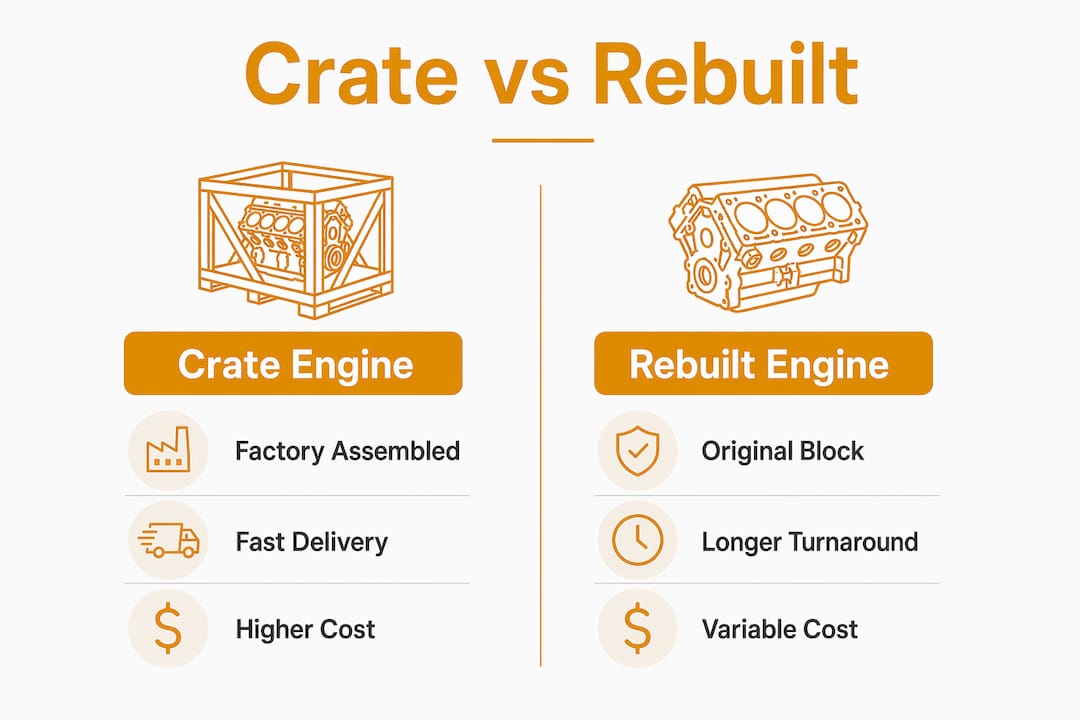
A full V8 engine rebuild may cost around $5,350 including machine work, rebuild kit, and labour, while a brand-new crate motor can cost around $7,300 ready to install with accessories. That $1,950 gap looks significant on paper, but it does not tell the full story. The rebuild figure assumes a quality shop, no surprises during disassembly, and no additional parts failures discovered mid-process.
The following cost factors apply to both options and are frequently underestimated:
- Installation labour. Labour costs around $1,200 to $1,800 regardless of whether the engine is a crate or rebuilt unit. This is a fixed cost that does not favour either option.
- Accessory adaptation. Modern crate engines, particularly performance units like an LS swap, may require transmission adapters, new mounts, standalone ECUs, or updated wiring harnesses. A full high-quality LS swap ecosystem can reach around $20,000 total once accessories are included.
- Downtime cost. A vehicle off the road for four months has a real financial cost, whether that is lost income for a tradie or hire car expenses for a daily driver. Downtime economics often outweigh simple upfront price differences, particularly for commercial and fleet vehicles.
- Warranty claims. A rebuild with a short or parts-only warranty can generate significant out-of-pocket costs if something fails within the first year.
| Cost factor | Crate engine | Rebuilt engine |
|---|---|---|
| Base engine price | Higher upfront (~$7,300 for V8) | Lower upfront (~$5,350 for V8) |
| Installation labour | $1,200 to $1,800 | $1,200 to $1,800 |
| Accessory costs | Can be significant for swaps | Usually minimal if same platform |
| Turnaround time | ~4 days | ~4 months |
| Warranty period | Typically 24 months or more | Varies widely by shop |
For more detail on Australian crate engine pricing, the figures above will differ depending on engine family, supplier, and whether you are sourcing a Hyundai, Kia, or performance unit.
What does warranty coverage actually protect you from?
Warranty duration is the number most people focus on, but it is the least useful metric for comparing engine protection. Warranty type affects real coverage far more than duration. A 36-month parts-only warranty can leave you paying thousands in labour costs if the engine fails at 18 months.
The three warranty structures you will encounter are:
- Parts-only coverage. The supplier replaces failed components but you pay all labour costs. This structure is common with budget rebuilders and some remanufacturers.
- Parts-and-labour coverage. The supplier covers both component replacement and workshop time. This is the standard for reputable crate engine suppliers and significantly reduces your financial exposure.
- Nationwide no-fault warranty. The strongest form of coverage, allowing claims at any authorised workshop without needing to return the engine to the original supplier. This matters most for fleet operators or anyone who travels.
A longer warranty period does not guarantee better protection if labour reimbursement is capped or exclusions apply. Common exclusions include improper installation, use of non-approved fluids, and failure to service the vehicle at specified intervals. Read the warranty document as you would a contract, because it is one.
Rebuild warranties vary enormously. A reputable independent shop may offer a 12-month parts-and-labour warranty with clear documentation. A budget rebuilder may offer nothing in writing at all. Crate engines from established suppliers typically carry standardised, documented warranties that are enforceable and transferable.
Pro Tip: Before accepting any engine warranty, ask specifically whether labour reimbursement is capped, which failure modes are excluded, and whether claims must be lodged through the original supplier or any authorised workshop.
When should you choose a crate engine vs a rebuilt engine?
The right answer depends on your vehicle, your budget, and what you are trying to achieve. There is no universal winner in the new engine vs rebuilt engine debate.
Choose a crate engine when:
- Your vehicle is a late-model daily driver or fleet unit where downtime is genuinely costly
- You need a predictable warranty with parts-and-labour coverage
- You are performing a platform swap and want a known-good baseline
- You cannot afford the risk of a rebuild uncovering additional problems mid-process
Choose a rebuilt engine when:
- Your vehicle is older and a crate replacement is unavailable or prohibitively expensive
- You are restoring a numbers-matching classic where originality matters
- You have a trusted rebuilder with documented procedures and a written warranty
- Your budget is fixed and the rebuild savings are material to the project
Crate engines are the preferred choice when uptime and predictable warranty support are critical, such as for commercial fleets or newer vehicles. Rebuilds suit owners with a trusted rebuilder, a tight budget, or a restoration project where maintaining the original engine block is part of the brief.
| Scenario | Better choice | Reason |
|---|---|---|
| Commercial fleet vehicle | Crate engine | Minimises downtime and warranty risk |
| Classic car restoration | Rebuilt engine | Preserves originality and numbers matching |
| Late-model daily driver | Crate engine | Predictable quality and longer warranty |
| Budget-conscious older vehicle | Rebuilt engine | Cost savings are more material |
| Performance build or swap | Crate engine | Known baseline for tuning and reliability |
For practical guidance on choosing the right crate engine for your specific vehicle and use case, the decision tree matters as much as the price tag.
Key takeaways
Choosing a crate engine delivers predictable quality, faster turnaround, and stronger warranty protection, while a rebuilt engine suits budget-conscious owners with a trusted shop and a vehicle where originality or parts availability makes rebuilding the logical path.
| Point | Details |
|---|---|
| Crate engine quality is consistent | Factory assembly and dyno testing remove the variability inherent in shop rebuilds. |
| Rebuild quality depends on the shop | Critical machining steps like boring, honing, and decking determine whether a rebuild is near-new or compromised. |
| Total cost includes more than engine price | Labour, accessories, and downtime can shift the cost comparison significantly in either direction. |
| Warranty type matters more than duration | Parts-and-labour coverage protects you far better than a longer parts-only warranty. |
| Vehicle use case drives the decision | Fleet and late-model vehicles favour crate engines; older restorations and tight budgets favour rebuilds. |
Why I always ask about the machining steps first
After years of watching engine replacement decisions play out, the single biggest mistake I see is treating this as a pure price comparison. People look at the rebuild quote, see a $2,000 saving over a crate unit, and sign off without asking a single question about the shop’s process. That is where things go wrong.
A rebuild from a shop that skips line-honing the mains or does not deck the block is not a $5,000 engine. It is a liability. I have seen vehicles back in the workshop within six months of a “budget rebuild” with oil consumption issues that a proper crate unit would never have produced. The crate engine’s biggest advantage is not the price or even the warranty. It is the predictability. You know exactly what you are getting before it goes in.
That said, I do not think rebuilds are always the wrong call. For a classic restoration or an older vehicle where a crate replacement simply does not exist, a quality rebuild from a reputable shop with a written warranty is a perfectly sound choice. The key word is reputable. Ask for references. Ask for their documented process. Ask what machining steps they perform as standard. A good rebuilder will answer those questions without hesitation.
The warranty fine print is the other area I always push people to read carefully. I have seen 36-month warranties that were effectively worthless because the labour reimbursement cap was $400 and the exclusions list covered almost every realistic failure mode. Compare that to a 24-month parts-and-labour warranty from a quality crate supplier and the shorter warranty is clearly the better protection.
— Jason
Find the right engine for your vehicle at Engine Zone
Engine Zone stocks a curated range of new crate engines for Hyundai and Kia vehicles, with transparent pricing, fitment guarantees, and fast delivery across Australia. Every engine is tested and backed by a warranty you can actually rely on.
Whether you are replacing a worn-out engine in a fleet vehicle or rebuilding a project car, the team at Engine Zone can help you match the right unit to your vehicle. Explore the benefits of new crate engines or find out how crate engines save labour time on your build. Discounts of up to 25% are available on selected units, with SSL-secured checkout and expert fitment support included.
FAQ
What is the main difference between a crate and rebuilt engine?
A crate engine is a brand-new, fully assembled unit with factory-level quality control and a standardised warranty. A rebuilt engine is a restored original unit whose quality depends entirely on the machine shop’s skill and the machining steps performed.
Are crate engines worth the extra cost?
For late-model vehicles, fleet operators, and anyone where downtime is costly, the premium is justified. The faster turnaround, stronger warranty, and predictable performance often outweigh the upfront price difference when total costs are compared.
How long does a rebuilt engine take compared to a crate engine?
Rebuilds typically take around four months due to machine shop scheduling and detailed machining processes. Crate engines can arrive within approximately four days, making them significantly faster for vehicles that cannot afford extended downtime.
What should I look for in a rebuilt engine warranty?
Focus on whether the warranty covers both parts and labour, whether labour reimbursement is capped, and what failure modes are excluded. A parts-only warranty with a long duration often provides less real protection than a shorter parts-and-labour policy.
Can I get a crate engine for a Hyundai or Kia in Australia?
Yes. Engine Zone specialises in new crate engines for Hyundai and Kia vehicles and offers fitment assistance, fast delivery across Australia, and warranties on all units. Contact the team directly for model-specific availability and pricing.