
Storing crate engines in your workshop safely
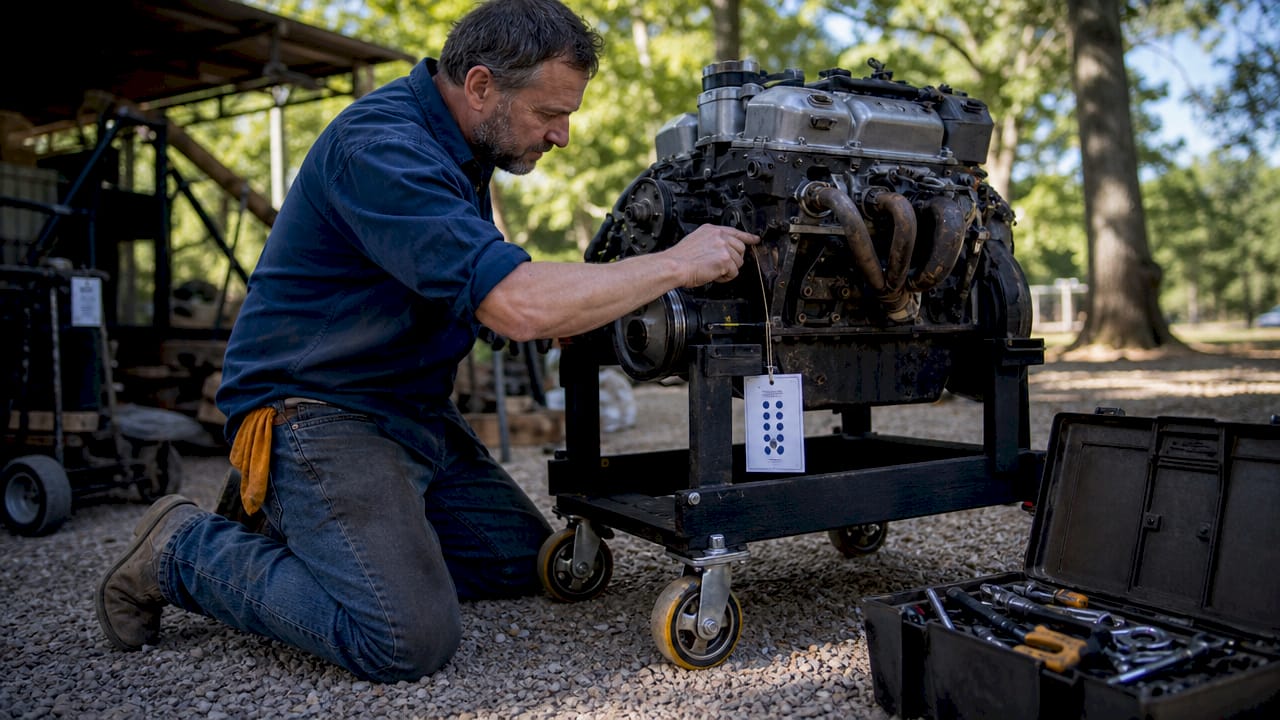
Proper crate engine storage is defined as the active management of a new or rebuilt engine unit to prevent corrosion, seal degradation, and mechanical damage during the period between delivery and installation. Storing crate engines workshop safely requires more than placing an engine on a stand and walking away. Without the right equipment, sealed openings, and regular preservation checks, a brand-new engine can suffer internal rust, contaminated oil galleries, and voided warranty before it ever turns a key. The tools that make the difference are heavy-duty motor cradles, desiccant bags, humidity indicator cards, and non-hydroscopic sealing tape.
What equipment is essential for safe crate engine storage?
The foundation of any safe engine storage setup is a purpose-built cradle rated for the load. Standard cradles must hold 750 lbs and carry four 3-inch swivel casters for stability and manoeuvrability across a workshop floor. That load rating matters because an undersized stand flexes under the engine block, creating instability during rotation or repositioning.
Beyond the cradle, you need a short list of sealing and humidity control materials:
- Engine plugs and non-hydroscopic tape to seal intake, exhaust, oil filler, and coolant ports
- Desiccant bags placed inside sealed cavities and in the immediate storage area
- Humidity indicator cards that change colour when moisture levels exceed safe thresholds
- Specialised storage oil to replace standard oil for engines held beyond 30 days
- Load-distributing pads placed under cradle casters on concrete floors
The table below shows the core equipment, its function, and the minimum specification to look for.
| Equipment | Function | Minimum spec |
|---|---|---|
| Motor cradle | Supports and mobilises engine | 750 lb rated, 3-inch swivel casters |
| Engine plugs and tape | Seals all external openings | Non-hydroscopic material |
| Desiccant bags | Absorbs ambient moisture | Silica gel, replaceable type |
| Humidity indicator cards | Monitors moisture levels | Colour-change at safe threshold |
| Storage oil | Protects internal surfaces | OEM-approved preservation grade |
| Load-distributing pads | Prevents stand movement on concrete | Rated for full engine weight |
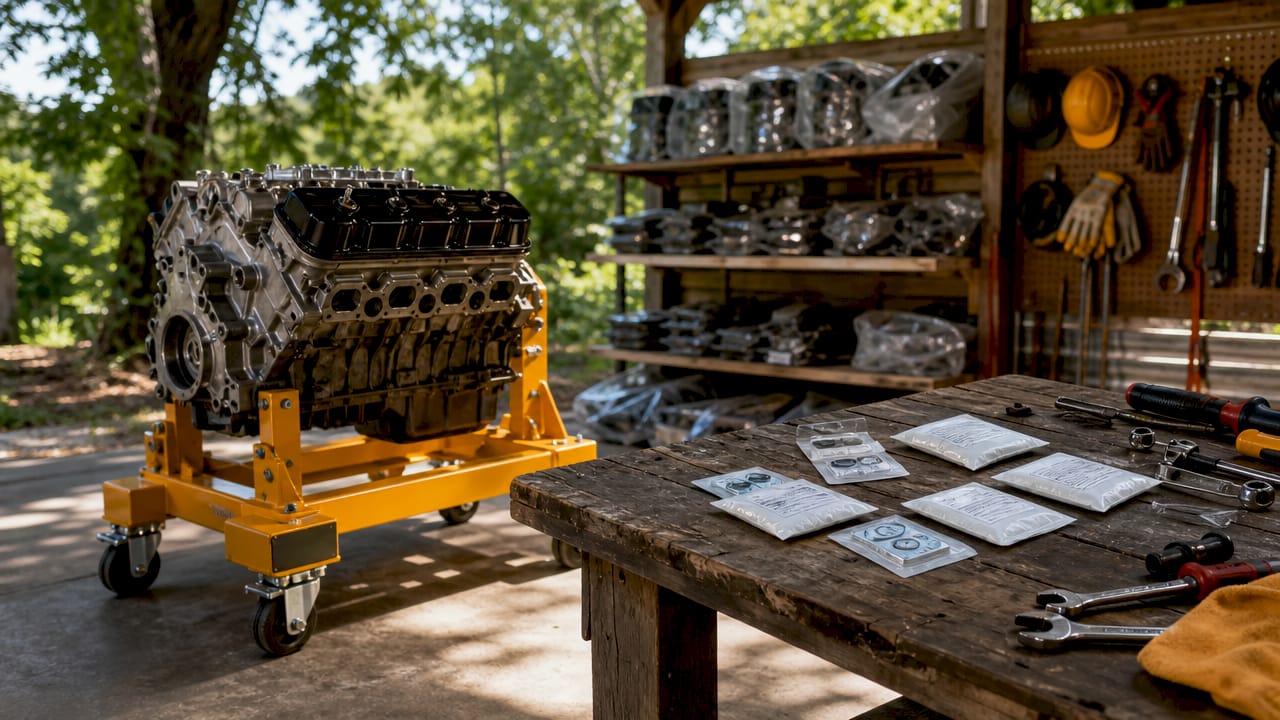
Pro Tip: Buy humidity indicator cards in bulk and tape one to the outside of each sealed engine opening. A quick visual check during your rounds tells you immediately whether the desiccant inside needs replacing.
How do you prepare and seal a crate engine for long-term storage?
Preparation is the step most workshops skip or rush. A dirty or damp engine surface traps moisture against metal and accelerates corrosion from day one. Follow these steps in order before the engine goes onto the cradle.
- Clean and dry the exterior. Wipe down all external surfaces with a clean, lint-free cloth. Remove any packing grease or transit residue. Allow the engine to reach ambient temperature before sealing.
- Drain and replace the oil. Long-term storage beyond 30 days requires replacing regular oil with specialised storage oil. Standard oil breaks down and leaves acidic residue on internal surfaces over time.
- Seal every opening. Fit rubber plugs or non-hydroscopic tape over the intake manifold ports, exhaust flanges, oil filler cap, coolant hoses, and breather ports. Any unsealed opening is a direct path for humid air.
- Place desiccant bags inside sealed cavities. Where the engine design allows access, place a desiccant bag inside the intake plenum or air box before sealing. This controls residual moisture trapped at the time of sealing.
- Attach humidity indicator cards. Fix a card to each sealed opening and one to the cradle itself. Record the date of placement in your storage log.
- Mount the engine on the cradle. Centre the block on the mounting points to distribute weight evenly. Uneven weight distribution on stands causes instability and creates a tipping risk during any subsequent movement.
- Position in the storage area. Allow at least 1 metre of clear space on all sides for safe access and manoeuvring.
Pro Tip: Photograph the sealed engine from multiple angles immediately after preparation. If a seal is disturbed or a plug goes missing, you have a reference point to identify exactly what changed.
What workshop environmental controls support engine storage safety?
The workshop itself is part of the storage system. A well-prepared engine placed in a poorly controlled environment will still degrade. Workshop ventilation is critical during any engine handling, because carbon monoxide and hydrocarbon concentrations can exceed short-term exposure limits within minutes in an enclosed space. Mechanical exhaust extraction is the standard, not an optional upgrade.
Floor condition is equally important. Concrete floors with load-distributing pads are the correct base for engine stands. Uneven or cracked flooring causes cradle casters to sit at different heights, which shifts the engine’s centre of gravity and increases tipping risk. Check floor integrity before positioning any stored engine.
Key environmental and safety requirements for the storage area include:
- Stable ambient temperature to reduce condensation cycles on metal surfaces
- Low humidity maintained below the threshold shown on your humidity indicator cards
- Mechanical ventilation with exhaust extraction rated for the workshop volume
- Clear manoeuvring lanes of at least 1 metre around each stored engine
- Inspected lifting equipment with weld fatigue and hydraulic leaks checked before every lift
Load-testing and inspecting lifting equipment before use prevents more accidents than equipment failure does. Weld fatigue and hydraulic leaks are the two most common failure points on workshop engine cranes.
Document every inspection. A written record of floor checks, ventilation tests, and lifting equipment inspections protects the workshop in the event of an incident and supports compliance with workplace health and safety obligations.
How often should preservation measures be renewed?
Storage beyond 30 days without preservation renewal rapidly degrades engine internals due to humidity fluctuations and seal breakdown. The standard maintenance interval is every 30–90 days, depending on ambient conditions in the workshop. Workshops in coastal or high-humidity regions should default to the 30-day end of that range.
Follow this renewal sequence:
- Inspect humidity indicator cards. If any card has changed colour to pink or the equivalent warning state, replace the desiccant bag behind that seal immediately.
- Check all seals and plugs. Press each plug firmly and run a finger along taped edges. Any lifting or cracking requires replacement before resealing.
- Rotate the engine manually (where the cradle design allows). Turning the engine through a partial rotation redistributes the storage oil across internal surfaces and prevents pooling on one side of bearings.
- Top up or replace storage oil if the level has dropped or the oil shows signs of contamination.
- Update the storage log. Record the date, the condition of each seal, the humidity card reading, and any actions taken.
Proper engine storage prevents warranty voids and expensive overhauls caused by undocumented preservation gaps. OEM manuals for most major manufacturers require specific storage and return-to-service actions to keep warranty valid. A detailed log is your evidence that those actions were completed on schedule.
Workshops managing multiple stored engines benefit from a simple spreadsheet or whiteboard tracker showing each engine’s last inspection date and next due date. This removes the reliance on memory and makes the renewal process part of the normal workshop routine rather than a reactive task.
What are the most common crate engine storage mistakes?
Most storage failures trace back to a small number of repeated errors. Knowing them in advance is the fastest way to avoid a costly engine write-off.
- Running partial warm-ups instead of proper preservation. Short engine runs without reaching full operating temperature increase internal condensation and cause more damage than no run at all. Engines should reach full operating temperature for at least 30 minutes to eliminate moisture. If that is not possible before storage, skip the run entirely and rely on storage oil and desiccant.
- Ignoring humidity indicator card changes. A pink card is not a suggestion. It means moisture has already entered the sealed area and desiccant replacement is overdue.
- Using the wrong stand or mounting the engine off-centre. An engine mounted unevenly on a cradle creates a tipping hazard every time the stand is moved. Always centre the block and verify the cradle’s load rating before mounting.
- Blocking manoeuvring space around stored engines. Stacking parts or equipment around a stored engine makes safe repositioning impossible and creates a trip hazard for anyone working nearby.
- Skipping the storage log. Without documentation, there is no way to confirm preservation intervals were met. This matters for warranty claims and for any installation checklist completed when the engine eventually goes into a vehicle.
Key takeaways
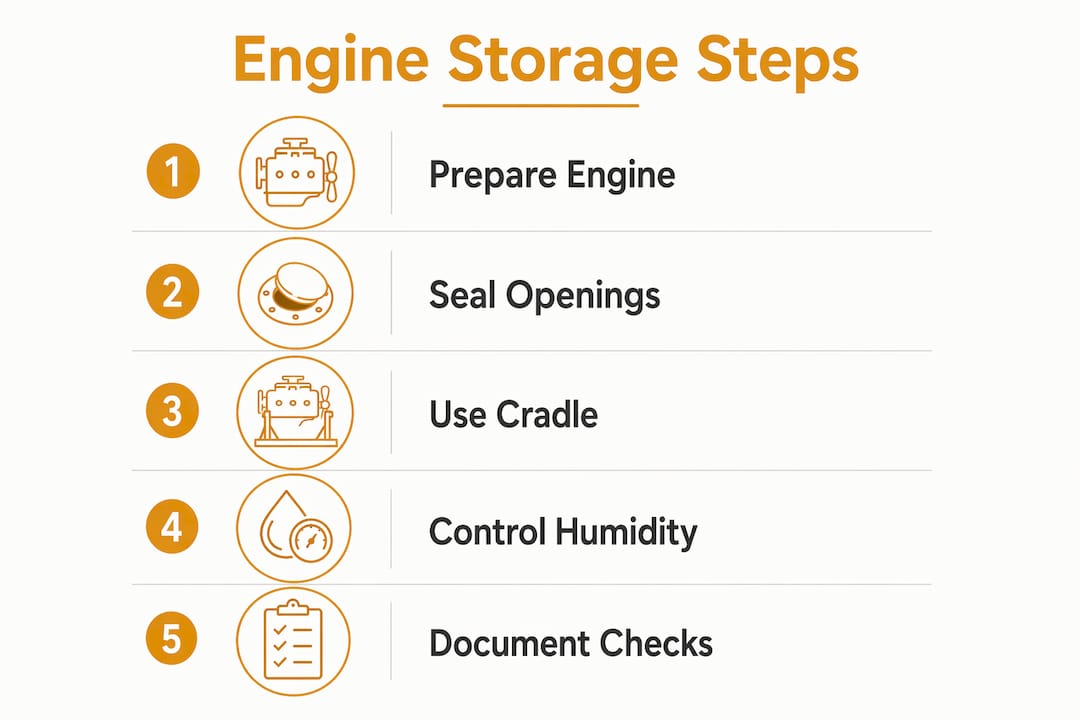
Safe crate engine storage requires a rated cradle, sealed openings, active humidity control, and documented preservation checks every 30–90 days to protect engine condition and workshop safety.
| Point | Details |
|---|---|
| Use a rated cradle | Choose a cradle rated to at least 750 lbs with 3-inch swivel casters for safe handling. |
| Seal every opening | Use non-hydroscopic tape and rubber plugs on all intake, exhaust, and oil ports before storage. |
| Monitor humidity actively | Place desiccant bags and humidity indicator cards at each sealed point and check monthly. |
| Renew preservation every 30–90 days | Replace storage oil, check seals, and rotate the engine on schedule to prevent internal corrosion. |
| Document every inspection | Keep a storage log to maintain warranty validity and support workplace safety compliance. |
Why I treat engine storage as a live job, not a waiting room
Most workshops I have visited treat stored engines the same way they treat a spare tyre on a shelf. Out of sight, out of mind. That approach is exactly how a $4,000 crate engine turns into a $6,000 problem before it ever gets bolted in.
The shift that changed how I think about this came from watching a workshop lose a brand-new engine to internal rust after six weeks of storage. The seals were intact. The stand was correct. But nobody had checked the humidity cards, and a wet winter had pushed moisture through a pinhole in one taped port. The damage was invisible from the outside and only showed up on the first compression test after installation.
Engine storage is an active management process requiring regular checks, not a passive action. The workshops that get this right treat each stored engine as a live job with a scheduled next action. They use a whiteboard, a spreadsheet, or even a handwritten card on the cradle. The format does not matter. The habit does.
The human factor is the real risk in any workshop. Safety culture and adherence to checklists reduce incidents more than any piece of equipment. A well-trained team that follows a documented process will outperform a workshop full of expensive gear operated by people who rely on memory.
If you take one thing from this, make it the 30-day rule. Set a recurring calendar reminder. Check the cards, check the seals, update the log. That 10-minute task is the difference between an engine that installs perfectly and one that needs a rebuild before it has run a single kilometre.
— Jason
Engine Zone: crate engines and storage support for Australian workshops
Engine Zone supplies new, tested, and guaranteed crate engines to Australian mechanics, dealerships, and fleet operators, with a focus on Hyundai and Kia fitment. Every engine ships with full documentation to support your storage and installation process.

Whether you are selecting your next engine or reviewing the benefits of new crate engines for an upcoming build, Engine Zone’s team can assist with model fitment, storage compatibility questions, and fast delivery across Australia. The shop carries engines with discounts up to 25% and SSL-secured checkout for trade buyers. Visit the Engine Zone engine selection guide to find the right unit for your workshop’s next project.
FAQ
How long can a crate engine be stored without preservation renewal?
A crate engine should not go beyond 30 days without a preservation check. Storage beyond 30 days without renewal risks internal corrosion and seal degradation that can void the manufacturer warranty.
What type of stand is safe for storing a crate engine?
Use a heavy-duty motor cradle rated to at least 750 lbs with four 3-inch swivel casters. Mount the engine centred on the stand to prevent tipping during movement or rotation.
Do I need to change the oil before storing a crate engine?
Yes. Standard engine oil should be replaced with specialised storage oil for any storage period beyond 30 days. Regular oil breaks down and leaves acidic residue on internal bearing surfaces.
How do I know when to replace the desiccant bags?
Replace desiccant bags immediately when the humidity indicator card changes colour, typically to pink. Check cards monthly as part of your standard preservation renewal routine.
Does improper storage void a crate engine warranty?
Yes. Most OEM manuals require documented storage and return-to-service procedures to maintain warranty validity. Keeping a detailed storage log is the clearest way to demonstrate compliance if a warranty claim is needed.